
Description
Understanding GLOW 70mg: An Educational Guide to GHK-Cu, BPC-157 and TB-500
Peptide science has become an increasingly active area of biomedical research over the past decade. Scientists continue to investigate naturally occurring peptides and synthetic peptide analogues to better understand how they interact with biological systems, influence cellular signalling, and contribute to tissue function.
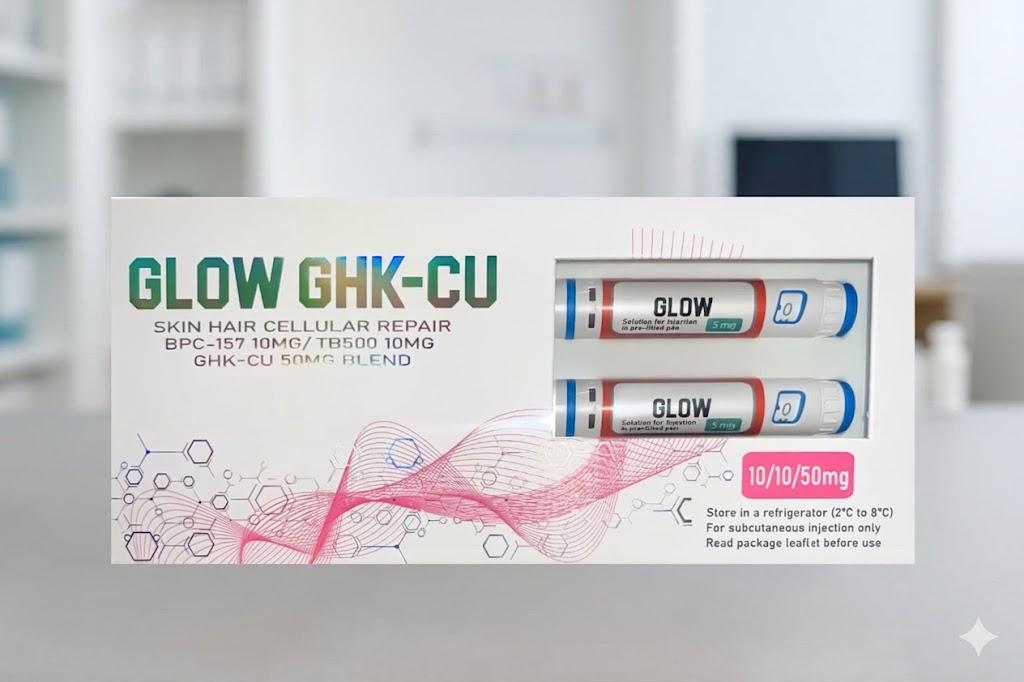
One formulation that combines several peptides into a single preparation is known as GLOW 70mg, a blend containing GHK-Cu, BPC-157, and TB-500. Each of these compounds has attracted scientific interest individually, while combination formulations are being explored to better understand how multiple peptides behave together under controlled laboratory conditions.
This article provides an overview of the formulation, the individual peptides it contains, current areas of scientific research, and the regulatory position in the United Kingdom.
What Is GLOW 70mg?
GLOW 70mg is a multi-peptide formulation containing three individual compounds:
- GHK-Cu (Copper Peptide)
- BPC-157
- TB-500
The total peptide content equals 70mg, comprising:
- 50mg GHK-Cu
- 10mg BPC-157
- 10mg TB-500
Rather than representing a single active compound, GLOW combines three peptides with distinct biological characteristics. Researchers may investigate combination formulations to better understand peptide stability, formulation compatibility, and the behaviour of multiple compounds within the same preparation.
Importantly, the presence of several peptides within one formulation does not necessarily imply additive or synergistic biological effects. Those questions remain the subject of ongoing scientific investigation.
Understanding GHK-Cu
GHK-Cu, also known as glycyl-L-histidyl-L-lysine copper, is a naturally occurring copper-binding peptide first identified in human plasma during the 1970s.
Over the years, researchers have examined GHK-Cu in relation to several biological processes, including:
- Cellular communication
- Tissue remodelling
- Extracellular matrix regulation
- Collagen production
- Wound healing mechanisms
- Skin biology
Because copper plays an important role in numerous enzymatic reactions throughout the body, scientists have also investigated how copper-bound peptides may influence signalling pathways involved in normal tissue maintenance.
In laboratory settings, GHK-Cu continues to be studied for its biochemical properties, molecular stability, and interactions with various delivery systems.
Although published research has generated considerable scientific interest, further clinical investigation is still required before definitive therapeutic conclusions can be drawn.
Understanding BPC-157
BPC-157 is a synthetic peptide derived from a naturally occurring protein found within gastric juice.
Scientific publications have explored BPC-157 across several experimental models involving:
- Tissue repair pathways
- Angiogenesis
- Cellular signalling
- Gastrointestinal biology
- Tendon and ligament research
Much of the available evidence currently comes from laboratory and animal studies. Human clinical evidence remains comparatively limited, and researchers continue to investigate both potential mechanisms and long term safety.
Because of this, BPC-157 remains an investigational compound rather than an approved medicine in the UK.
Understanding TB-500
TB-500 is a synthetic peptide fragment based on thymosin beta-4, a naturally occurring protein involved in several biological processes.
Researchers have investigated thymosin beta-4 and related peptide fragments in connection with:
- Cell migration
- Tissue organisation
- Inflammatory signalling
- Cellular differentiation
- Wound healing biology
TB-500 has been examined in preclinical research to better understand how peptide fragments may interact with these biological pathways.
As with many investigational peptides, much of the available evidence comes from experimental rather than routine clinical use, and additional high-quality human studies are needed.
Why Study Combination Peptide Formulations?
Scientists do not always study peptides individually. In some areas of pharmaceutical development, researchers investigate formulations containing multiple compounds to evaluate characteristics that cannot be assessed when each peptide is examined separately.
Examples include:
- Physical stability
- Chemical compatibility
- Solution behaviour
- Storage characteristics
- Delivery system performance
- Manufacturing consistency
Combination formulations also allow researchers to observe whether multiple compounds remain chemically stable when stored together over time.
These investigations are important during formulation development but do not establish clinical effectiveness.
Peptide Stability and Storage
Peptides are relatively delicate molecules that can be influenced by environmental conditions.
Factors that may affect peptide stability include:
- Temperature
- Light exposure
- Moisture
- Oxygen
- Mechanical agitation
- Repeated freeze-thaw cycles
For this reason, many peptide products are transported using temperature-controlled packaging and stored under refrigerated conditions before laboratory handling.
Following appropriate storage recommendations helps reduce the likelihood of degradation during transport and storage.
Quality Control in Peptide Manufacturing
Modern peptide manufacturing generally involves multiple quality assurance procedures designed to verify product identity and consistency.
Depending on the manufacturer, quality control may include:
- Identity confirmation
- Purity analysis
- Batch traceability
- Manufacturing documentation
- Packaging inspection
- Stability testing
Different manufacturers may use different analytical techniques and quality standards, which is why batch documentation is often an important part of peptide production.
Current Research Landscape
Research into peptides has expanded considerably in recent years across universities, biotechnology companies, and pharmaceutical organisations.
Scientists continue to investigate peptides for a wide range of potential applications in areas including:
- Metabolic health
- Dermatology
- Regenerative biology
- Gastrointestinal science
- Musculoskeletal research
- Drug delivery technologies
Many investigational peptides show promising findings during early laboratory work but ultimately require extensive clinical evaluation before regulatory authorities can determine whether they are safe and effective for routine medical use.
Regulatory Status in the United Kingdom
In the United Kingdom, medicines must undergo rigorous evaluation before they can receive marketing authorisation.
This process involves reviewing evidence relating to:
- Quality
- Safety
- Clinical effectiveness
- Manufacturing standards
Many peptides currently discussed within scientific literature remain investigational compounds and have not been authorised as medicines by UK regulators for routine clinical use.
Researchers and organisations working with investigational compounds are expected to follow applicable laboratory procedures, institutional policies, and relevant regulatory requirements.
Frequently Asked Questions
What are peptides?
Peptides are short chains of amino acids that act as signalling molecules throughout the body. They play important roles in many normal biological processes.
Why are peptides studied?
Researchers investigate peptides to better understand biological pathways and explore whether certain compounds may have future therapeutic applications.
Are all peptides approved medicines?
No. Many peptides remain investigational and are still being evaluated through laboratory and clinical research.
Why are combination formulations studied?
Combination formulations allow scientists to investigate formulation stability, compatibility, storage behaviour, and manufacturing characteristics when multiple compounds are present together.
Why is temperature important?
Many peptides are temperature sensitive. Appropriate storage helps preserve chemical stability and product integrity during transport and handling.
Is research into these peptides still ongoing?
Yes. Scientific understanding continues to evolve as new laboratory findings and clinical studies are published.
Summary
Peptide science continues to develop rapidly, with compounds such as GHK-Cu, BPC-157, and TB-500 attracting ongoing interest from researchers worldwide. Each peptide has distinct biochemical characteristics and remains the subject of active investigation across multiple scientific disciplines.
While early findings have generated considerable interest, these compounds continue to be evaluated through laboratory and clinical research. As with all investigational molecules, conclusions regarding safety, effectiveness, and potential medical applications depend on the quality and outcomes of future scientific studies.


Reviews
There are no reviews yet.