If you’re researching retatrutide, one question you’re likely to come across is how long it remains in the body after an injection.
Understanding how long a medicine stays in your system can help explain why it’s given once a week, how long its effects may last, and why it can take time to completely leave the body after treatment stops.
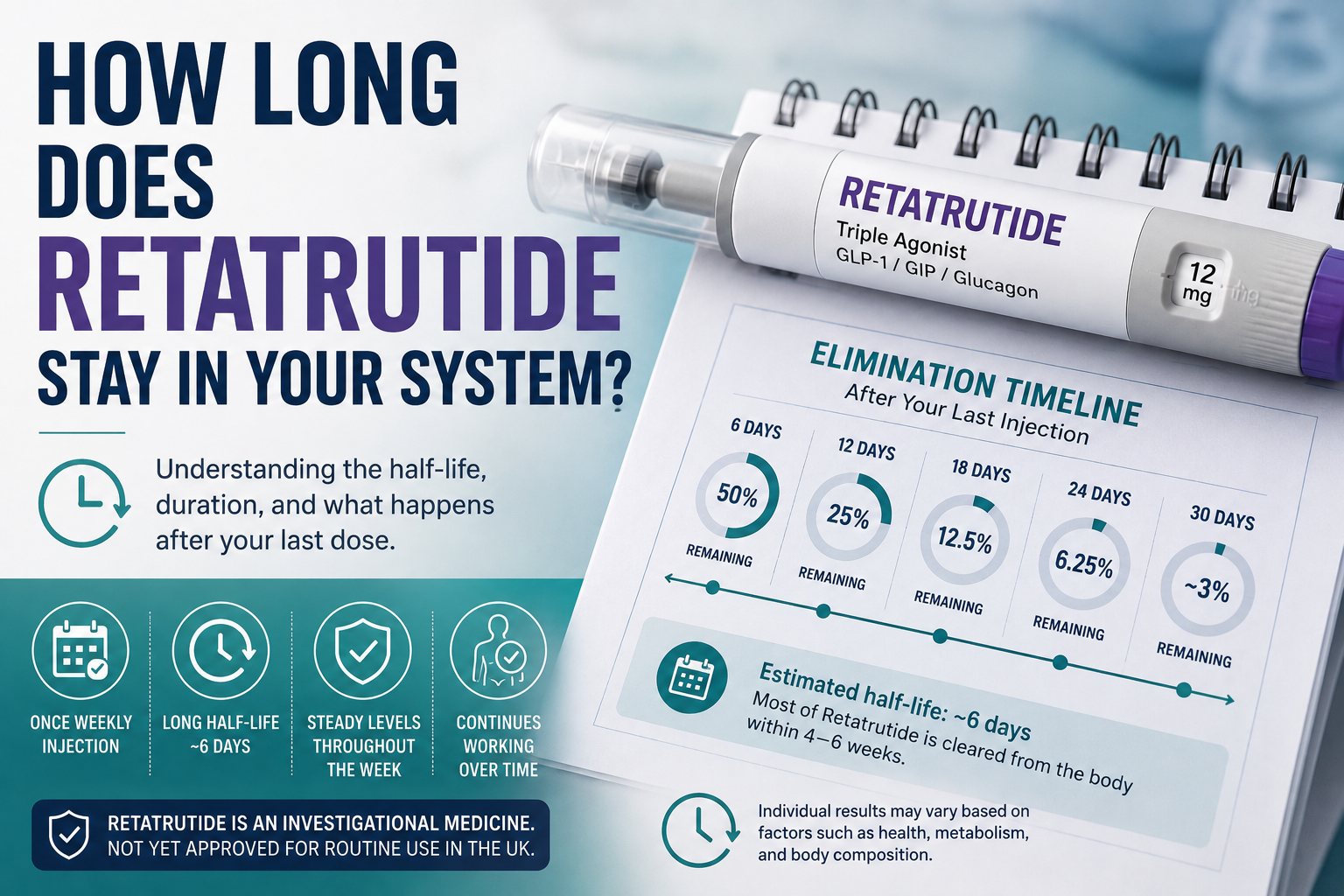
Based on the available clinical research, retatrutide has an estimated half-life of approximately six days. This means it takes around six days for the amount of the medicine in your body to reduce by half. Because of this relatively long half-life, retatrutide has been studied as a once weekly injection in clinical trials. Current evidence suggests it may take around four to six weeks for most of the medicine to leave the body after the final dose, although this can vary between individuals.
What Does “Half-Life” Mean?
The term half-life refers to the amount of time it takes for half of a medicine to be eliminated from the body.
For example, imagine you receive a single dose of retatrutide.
After approximately six days:
- Around 50% remains.
- After another six days, around 25% remains.
- Six days later, roughly 12.5% remains.
The amount gradually becomes smaller until only tiny traces remain.
Medicines are generally considered to be effectively cleared after about five half-lives.
How Long Does Retatrutide Stay in the Body?
Using its estimated six-day half-life, the timeline looks approximately like this:
| Time After Final Dose | Approximate Amount Remaining |
|---|---|
| 6 days | 50% |
| 12 days | 25% |
| 18 days | 12.5% |
| 24 days | 6.25% |
| 30 days | Around 3% |
This is why healthcare professionals often estimate that retatrutide may remain in the body for around one month or slightly longer after the final injection.
These figures are estimates based on average pharmacokinetic data. Individual differences mean the exact timing can vary.
Why Does Retatrutide Last So Long?
Retatrutide was specifically designed to remain active in the body for an extended period.
A longer half-life offers several advantages:
- Only one injection each week.
- More stable medicine levels between doses.
- Less frequent dosing than medicines with shorter half-lives.
- Continuous activation of the hormone receptors being studied.
This longer duration is one of the reasons weekly injections have become common for newer weight management medicines.
Does Retatrutide Keep Working Throughout the Week?
Yes.
One reason researchers designed retatrutide with a long half-life was to maintain relatively steady activity between weekly injections.
Rather than creating a sharp rise followed by a rapid drop, medicine levels decline gradually throughout the week. This helps support consistent activation of the hormone pathways targeted by retatrutide.
Does Body Weight Affect How Long Retatrutide Lasts?
Possibly, but only to a limited extent.
Factors that may influence how a medicine is processed include:
- Body weight.
- Kidney function.
- Liver function.
- Age.
- Overall health.
- Individual metabolism.
However, these differences are usually much smaller than many people expect. The six-day half-life reported in studies represents an average across many participants.
What Happens If You Miss a Weekly Dose?
Because retatrutide remains in the body for several weeks, medicine levels do not disappear immediately after a missed injection.
However, missing doses regularly could reduce the consistency of treatment.
As retatrutide is still investigational, anyone participating in a clinical trial should follow the study protocol and instructions provided by the research team.
Can Side Effects Continue After Stopping Retatrutide?
They can.
Because the medicine gradually leaves the body rather than disappearing overnight, some effects may continue for a period after the final injection.
The duration varies from person to person and depends on factors such as:
- The dose received.
- How long treatment continued.
- Individual metabolism.
- Personal sensitivity to the medicine.
How Does Retatrutide Compare With Other Weekly Weight Loss Medicines?
Retatrutide has a half-life similar to several other long-acting weekly injectable medicines.
Like other medicines in this class, it was developed to support convenient once-weekly dosing rather than requiring daily injections.
Although the exact half-life differs slightly between medicines, the overall principle is similar: a longer half-life allows for less frequent dosing while maintaining relatively stable drug levels.
Why Is This Important for Weight Loss?
Retatrutide works by activating hormone receptors involved in appetite regulation, insulin response, and energy expenditure.
These biological effects depend on maintaining adequate medicine levels over time.
If the medicine disappeared after only a day or two, much more frequent injections would likely be necessary.
Its long half-life helps provide continuous receptor activation throughout the week, which is one reason researchers have chosen a weekly dosing schedule.
Frequently Asked Questions
What is the half-life of retatrutide?
Current research estimates that retatrutide has a half-life of approximately six days.
How long does retatrutide stay in your body?
Most of the medicine is expected to be eliminated within four to six weeks after the final injection, although this varies between individuals.
Why is retatrutide only injected once a week?
Its long half-life allows medicine levels to remain active throughout the week, making weekly injections sufficient in clinical studies.
Does retatrutide leave the body immediately?
No. Like many long-acting injectable medicines, retatrutide gradually leaves the body over several weeks rather than disappearing after a few days.
Final Thoughts
Retatrutide has an estimated half-life of around six days, making it suitable for once-weekly dosing in clinical research. Although each injection begins to decline soon after administration, the medicine leaves the body gradually, with most of it being eliminated over approximately four to six weeks after the final dose.
Understanding this timeline helps explain why weekly injections are possible and why both the effects and any side effects may continue for some time after treatment stops.
As retatrutide remains an investigational medicine, ongoing clinical trials will continue to provide more information about its long-term safety, effectiveness, and pharmacokinetics.