Retatrutide has become one of the most talked about investigational weight loss injections, mainly because early and late stage clinical trials have reported unusually strong weight loss results.
But when people read about retatrutide online, dosing can get confusing very quickly. You may see 1 mg, 4 mg, 8 mg, 9 mg, 12 mg, starting doses, escalation schedules, and weekly injections all mentioned in different places.
So, what doses have actually been used in clinical studies?
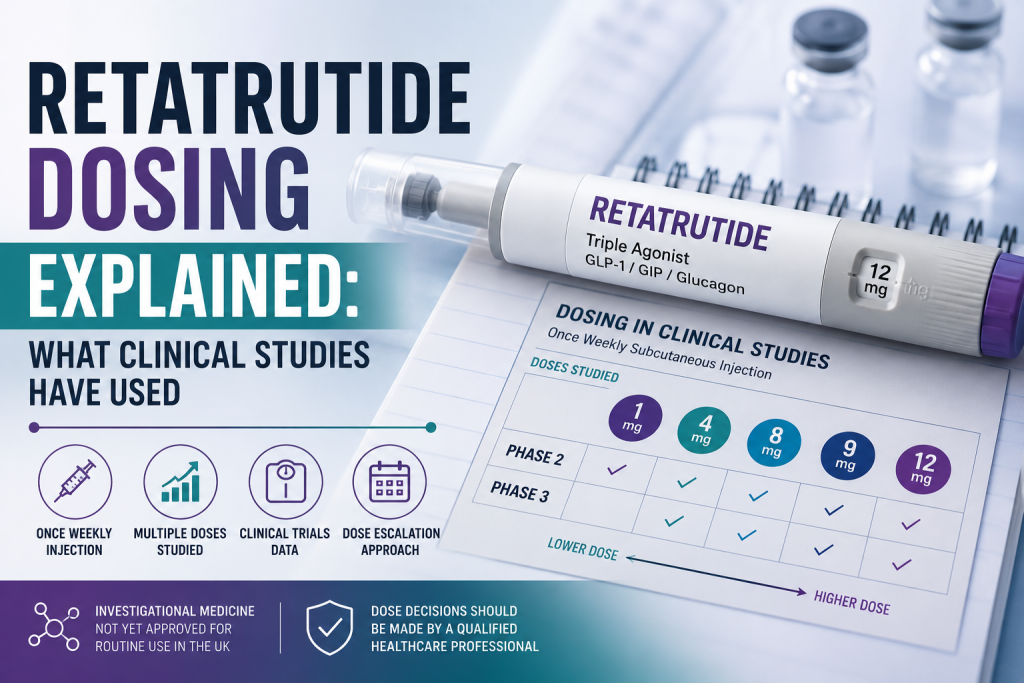
In clinical trials, retatrutide has been studied as a once weekly injection, with doses including 1 mg, 4 mg, 8 mg, 9 mg, and 12 mg, depending on the trial phase and study design. Retatrutide is still investigational, so there is currently no approved standard UK dosing schedule for routine weight loss treatment.
What Is Retatrutide?
Retatrutide is an investigational medicine being studied for obesity and weight management. It is known as a triple hormone receptor agonist because it acts on three hormone pathways:
GLP-1, which helps regulate appetite and fullness.
GIP, which is involved in insulin response and metabolism.
Glucagon, which may influence energy expenditure and fat metabolism.
This makes retatrutide different from medicines that only target GLP-1, and also different from tirzepatide, which targets GLP-1 and GIP but not glucagon.
How Is Retatrutide Given in Studies?
In clinical studies, retatrutide has been given as a once weekly subcutaneous injection. Subcutaneous simply means the injection is given under the skin, usually in areas such as the abdomen, thigh, or upper arm.
This weekly format is similar to several other modern weight loss injections, but the dose and escalation pattern used for retatrutide is specific to the trial design.
Retatrutide Doses Used in Phase 2 Studies
One major Phase 2 trial published in the New England Journal of Medicine studied retatrutide in adults with obesity or overweight. Participants received different weekly doses, including:
| Study Dose | Notes |
|---|---|
| 1 mg | Lower dose group |
| 4 mg | Some participants started directly at 4 mg |
| 4 mg | Some participants started at 2 mg before moving to 4 mg |
| 8 mg | Some participants started at 2 mg before moving up |
| 8 mg | Some participants started at 4 mg before moving up |
| 12 mg | Higher dose group |
This matters because the trial did not only test the final dose. It also looked at how different starting doses and dose escalation patterns affected tolerability and results.
Why Did Some Groups Start Lower?
With medications that affect appetite and digestion, researchers often use dose escalation. That means participants may start on a lower amount before moving to a higher maintenance dose.
The reason is simple: the body needs time to adjust.
Medicines in this category can cause digestive side effects such as nausea, vomiting, diarrhoea, constipation, and reduced appetite. Starting lower and increasing gradually may help reduce side effects, although it does not remove the risk completely.
Retatrutide Doses Used in Phase 3 Studies
Later Phase 3 studies have focused on higher dose ranges. In the TRIUMPH-1 Phase 3 obesity trial, retatrutide was studied at:
| Dose | Frequency |
|---|---|
| 4 mg | Once weekly |
| 9 mg | Once weekly |
| 12 mg | Once weekly |
| Placebo | Once weekly |
In this trial, participants receiving retatrutide lost significantly more weight than those receiving placebo. Average weight loss after 80 weeks ranged from 19.0% with 4 mg to 28.3% with 12 mg.
Does a Higher Dose Mean More Weight Loss?
In the studies reported so far, higher doses have generally been linked with greater average weight loss.
For example, in the Phase 3 TRIUMPH-1 trial:
| Retatrutide Dose | Average Weight Loss at 80 Weeks |
|---|---|
| 4 mg | Around 19.0% |
| 9 mg | Around 25.9% |
| 12 mg | Around 28.3% |
So yes, the higher dose groups generally lost more weight on average. But that does not mean a higher dose is automatically “better” for every person.
Higher doses may also bring a greater chance of side effects, especially digestive symptoms. In real medical practice, the best dose usually depends on effectiveness, tolerability, medical history, and clinician guidance.
Is There an Approved Retatrutide Dosage in the UK?
No. Retatrutide is still an investigational medicine. That means there is no officially approved UK dosage for routine weight loss treatment yet.
The doses discussed in this article are from clinical trials, not prescribing instructions for public use.
This distinction is important. Clinical trial dosing is carefully controlled, monitored, and reviewed by medical professionals. It should not be copied outside a regulated medical setting.
Can People Choose Their Own Retatrutide Dose?
No. Retatrutide dosing should not be self selected.
Even with approved weight loss injections, dosing decisions should be made by a qualified healthcare professional. This is even more important with retatrutide because it is still being studied and has not yet gone through the full approval process for routine use in the UK.
Self dosing can be risky, especially if someone is using unregulated products or research labelled products from unreliable sources.
What Side Effects Are Dose Related?
The most commonly reported side effects in retatrutide studies have been gastrointestinal. These may include:
Nausea.
Vomiting.
Diarrhoea.
Constipation.
Reduced appetite.
Indigestion or stomach discomfort.
These side effects are common across several incretin based weight loss treatments, but the frequency and severity can vary by dose and individual response.
Why Dosing Studies Matter
Dosing studies are not just about finding the strongest dose. They help researchers understand several things:
How much weight people lose at each dose.
Which dose gives the best balance between results and side effects.
Whether gradual dose escalation improves tolerability.
How long people can safely remain on treatment.
Whether different groups of people respond differently.
This is why clinical trials test multiple doses instead of jumping straight to the highest amount.
Final Thoughts
Retatrutide has been studied as a once weekly injection, with clinical trial doses ranging from 1 mg to 12 mg. Earlier Phase 2 studies explored several dose levels and escalation patterns, while later Phase 3 obesity studies have focused mainly on 4 mg, 9 mg, and 12 mg weekly doses.
So far, higher doses have generally produced greater average weight loss, but dosing is about more than just results. Safety, side effects, tolerability, and long term outcomes all matter.
For now, retatrutide remains investigational. There is no approved UK dosing schedule for routine treatment, and the doses used in studies should be understood as research data, not personal medical instructions.